The Chief Information Officer (CIO) speaks in terms of servers, uptime, network latency, and petabytes of storage. The Chief Financial Officer (CFO) speaks in terms of operating expenses (OPEX), capital expenditures (CAPEX), depreciation schedules, and budget variances. Meanwhile, the Business Unit leader speaks in terms of time-to-market, customer acquisition costs, operational agility, and bottom-line revenue.
When these three leaders sit at a boardroom table to discuss the enterprise technology budget, it often sounds as though they are speaking entirely different, mutually unintelligible languages. This fundamental lack of a shared vocabulary leads to organizational friction, mistrust, misaligned strategic priorities, and ultimately, millions of dollars in wasted technology investments. This is where Technology Business Management (TBM) helps. TBM is a comprehensive, data-driven framework and management discipline designed to help organizations categorize, track, and analyze their IT costs. Its ultimate goal is to align technology spending directly with business value. At the very core of this powerful framework lies the TBM Taxonomy (defined as a standardized, hierarchical classification system that acts as the universal translator between IT, Finance, and the Business).
The Genesis and Purpose of the TBM Taxonomy
To understand the value of the TBM Taxonomy, we must first ask: why do we need a standardized taxonomy in the first place?
Consider the world of corporate finance. Financial professionals and accountants worldwide rely on Generally Accepted Accounting Principles (GAAP) or International Financial Reporting Standards (IFRS). These frameworks ensure that when a company reports its financial health, the information is consistent, transparent, and instantly comparable across the entire industry. For decades, there was no equivalent framework for dealing with the financials of the IT. Historically, organizations tracked their IT spend purely through the corporate General Ledger (GL). The GL is excellent at telling you what commodities were purchased. For instance, it will clearly show that you spent $10 million on software licenses, $5 million on hardware, and $2 million on external consultants. However, the GL is terrible at telling you why those purchases were made or who within the business is actually consuming them. You might know you spent a fortune on cloud infrastructure this quarter, but you cannot easily attribute that specific cost to the new mobile banking application that the Marketing department just launched.
Recognizing this massive visibility gap, the TBM Council (a non-profit professional organization comprising thousands of CIOs, CTOs, CFOs, and technology leaders) developed and now governs the TBM Taxonomy. The goal was simple yet incredibly ambitious: create a standard, common language that normalizes language of technology and business unlocking benefits by value realization. By adopting this uniform taxonomy, organizations can stop debating the accuracy of the data. They can benchmark their spending against industry peers, automate complex financial reporting, and successfully transition from subjective, defensive debates about IT costs to objective, data-driven conversations about maximizing business value.
The Layers of the TBM Taxonomy
The TBM Taxonomy is structured as a robust, multi-layered hierarchy. It is designed to map raw, uncontextualized financial data from the General Ledger all the way up to high-level business capabilities. This transformation is typically achieved through a TBM allocation model, which systematically flows costs upward through distinct layers. Let us break down these foundational layers in detail:
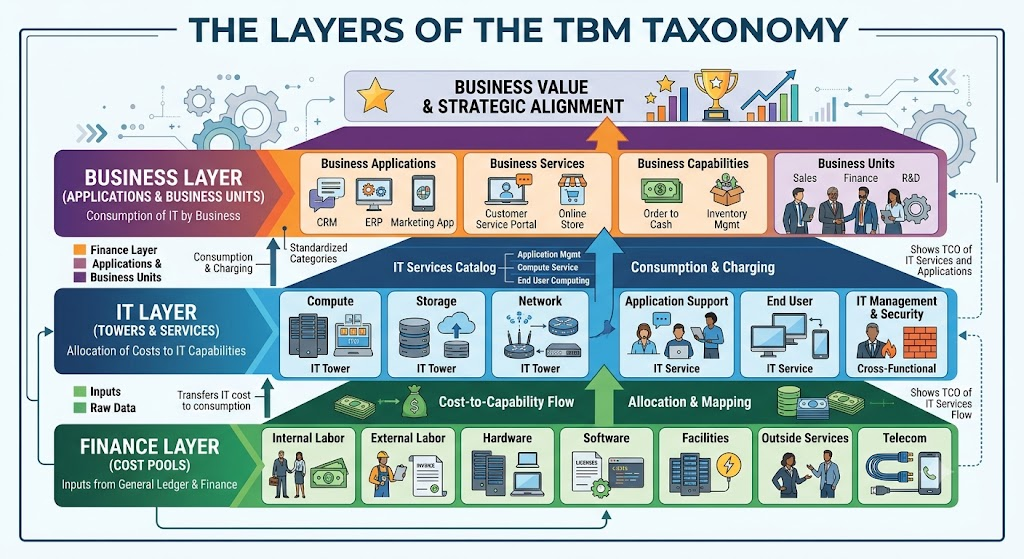 Layers of the TBM Taxonomy
1. The Finance Layer: Cost Pools and Sub-Pools
At the absolute foundational level of the taxonomy, we have the Finance view. This layer takes the raw accounting data from the general ledger entries and categorizes them into standard, universally recognized IT cost pools. By grouping expenses into these standardized buckets, organizations can eliminate the confusion caused by hundreds of disparate GL account codes.
Standard Cost Pools in the taxonomy include:
-
Internal Labor: The fully loaded costs of full-time employees, including base salaries, benefits, taxes, and bonuses.
-
External Labor: Costs associated with contractors, third-party consultants, and temporary staff augmentation.
-
Hardware: Physical assets including servers, storage arrays, network equipment, and end-user devices like laptops and peripherals.
-
Software: Perpetual software licenses, modern SaaS subscriptions, and ongoing maintenance and support fees.
-
Outside Services: Comprehensive managed services, outsourcing contracts, and specialized professional services.
-
Facilities and Power: The physical footprint of IT operations, including data center real estate, rent, utilities, and specialized cooling systems.
-
Telecom: Voice and data network expenses, internet connectivity, and corporate mobile plans.
The TBM Taxonomy strongly recommends keeping Capital Expenditure (CAPEX) and Operating Expenditure (OPEX) distinctly separated within these cost pools to maintain accurate cash flow tracking and depreciation visibility.
2. The IT Layer: IT Towers and Sub-Towers
Once basic costs are successfully grouped into Cost Pools, they are allocated upward to IT Towers and Sub-Towers. This represents the “IT view.” IT Towers categorize the actual technological resources, infrastructure, and functions that the IT department manages and provisions on a daily basis. This layer is vital for helping IT leaders understand the total cost of ownership (TCO) for specific technology domains.
Standard IT Towers include:
-
Data Center: The facilities and environmental controls housing the infrastructure.
-
Compute: Mainframes, physical servers, and modern virtualized environments (including Infrastructure as a Service).
-
Storage: Storage Area Networks (SAN), Network Attached Storage (NAS), and backup/archive environments.
-
Network: Local Area Networks (LAN), Wide Area Networks (WAN), voice networks, and transport layers.
-
Application Development & Support: The labor and tooling costs associated with developing, maintaining, and supporting software applications.
-
End User: The technology directly consumed by the workforce, such as standard workspaces, mobile devices, and helpdesk/service desk operations.
-
IT Management & Security: Cross-functional overhead, enterprise architecture, project management offices (PMO), and crucial cybersecurity initiatives.
By analyzing spend at the Tower level, a CIO can easily benchmark their storage cost-per-gigabyte or compute cost-per-instance against industry standards to identify operational inefficiencies.
3. The Delivery Layer: Solutions (Applications and Services)
This is the critical juncture where the magic of translation truly begins. Business leaders generally do not care about “Compute Towers” or “Network Latency”; they care deeply about the CRM system their sales team uses every day or the e-commerce platform that drives revenue. The Solutions layer bridges the gap between raw, technical IT infrastructure and business-facing deliverables.
Solutions are typically broken down into:
-
Business Applications: Complex software systems that directly support and enable business processes (e.g., Salesforce, SAP ERP, Workday HRIS, or a custom-built mobile application).
-
IT Services: Standardized, cataloged offerings provided to the business or end-users (e.g., “Standard Employee Workspace,” “Guest Wi-Fi Setup,” or “Premium Data Analytics Service”).
Allocating Tower costs to specific Solutions requires complex mapping. For example, the true total cost of an HR Application is not just the annual software license fee. It must include the fraction of the Compute tower it runs on, the Storage it consumes, the internal Application Labor required to maintain it, and the Helpdesk (End User) support it necessitates. The TBM Taxonomy ensures this calculation is highly comprehensive and defensible.
4. The Business Layer: Units and Capabilities
The absolute pinnacle of the TBM Taxonomy hierarchy is the Business view. This layer answers the ultimate, most strategic question: Which parts of the business are actually consuming IT resources, and what specific business capabilities are those resources enabling?
-
Business Units: This involves allocating the costs of Solutions back to the specific departments, divisions, or geographic regions that consume them (e.g., Retail Banking, Human Resources, Global Marketing). This enables accurate “Showback” or formal “Chargeback” models, making business leaders financially accountable for their technology consumption behavior.
-
Business Capabilities: Mapping IT spend to high-level strategic functions, such as “Supply Chain Management,” “Customer Acquisition,” “Payroll Processing,” or “Risk Management.”
When IT spend is accurately mapped to this final layer, the executive conversation shifts fundamentally. The CFO is no longer asking, “Why did our server costs go up by 10%?” Instead, they can clearly see that the “Customer Acquisition” capability required more technological resources because of a wildly successful, high-traffic new marketing campaign. Technology transforms from being viewed as a black-hole cost center to being recognized as a strategic enabler of business growth.
The Allocation Model
The taxonomy itself is just the vocabulary; the grammar that puts it all together is the TBM Allocation Model. A TBM model maps actual costs from the general ledger through the taxonomy layers using specific allocation rules.
Common allocation strategies include:
-
Even Spread: Dividing costs equally across all consumers (rarely accurate, but useful as a starting point).
-
Manually Assigned Percentages or Weighting: Using expert judgment to determine how costs should be split.
-
Direct Spend Weighting: Allocating shared overhead based on the proportion of direct spend.
-
Consumption-Based: The gold standard of allocation, where costs are assigned based on actual usage metrics (e.g., gigabytes of storage used, number of helpdesk tickets submitted, or cloud compute hours consumed).
The Strategic Business Value of Implementing the TBM Taxonomy
Why should an enterprise go through the rigorous, often challenging exercise of implementing this taxonomy? The strategic benefits extend far beyond generating neat financial spreadsheets.
-
Defensible Cost Allocation and Fostering Trust: When IT attempts to charge a business unit for services without a standard, transparent model, the business unit often pushes back, questioning the math and the validity of the charges. The TBM Taxonomy provides a highly transparent, standardized allocation mechanism. When business leaders understand exactly how the costs were calculated and what levers they can pull to reduce them, profound trust replaces historic suspicion.
-
Application Rationalization (AppRat): Most large, mature enterprises suffer from severe application bloat. They might have five different redundant project management tools or legacy systems that are practically abandoned by users but are still incurring massive backend infrastructure costs. By mapping total costs (including infrastructure and support) to the Application layer, IT can easily identify redundant or low-value applications and aggressively decommission them, driving massive cost savings.
-
Shifting Spend from “Run” to “Grow”: A core metric unlocked by TBM is the ratio of “Run-the-Business” (keeping the lights on, basic maintenance) versus “Grow/Transform-the-Business” (innovation, new capabilities) spend. The taxonomy gives organizations the baseline visibility needed to optimize operational costs and consciously redirect those freed-up funds toward strategic, customer-centric innovation initiatives.
-
Enhanced Strategic Decision Making: With a clear view of IT unit economics, executives can make informed build-vs-buy decisions, accurately price their own digital products, and measure the true return on investment of massive digital transformation programs.
The Intersection of TBM and FinOps
In recent years, the rapid acceleration of cloud computing has given rise to FinOps (Cloud Financial Management). While some may view FinOps and TBM as competing frameworks, they are actually highly complementary.
FinOps is highly tactical and focuses heavily on the variable, decentralized, and dynamic nature of cloud economics. It excels at optimizing cloud rates and usage on a day-to-day basis. However, enterprise IT is rarely 100% cloud.
The TBM Taxonomy provides the overarching, macro-level framework that encompasses all technology investments including both traditional on-premises infrastructure and modern multi-cloud services. When FinOps data is integrated into the TBM Taxonomy, organizations achieve a holistic view of their entire technology estate, ensuring that every dollar spent, whether in an AWS data center or a corporate basement server room, is aligned with strategic business objectives.
Overcoming Challenges in Adoption and Implementation
Adopting the TBM Taxonomy is a major transformational journey, and it is certainly not without its hurdles.
The most significant and pervasive challenge is foundational data quality. The taxonomy relies entirely on accurate data inputs from the General Ledger, Configuration Management Databases (CMDB), HR systems, and IT asset management platforms. If your CMDB is hopelessly outdated or your GL codes are a chaotic mess, the resulting TBM model will be fundamentally flawed. The old adage “garbage in, garbage out” is the golden rule of TBM. Organizations must be willing to invest time and resources in data hygiene and governance before they can fully reap the benefits of the taxonomy.
Furthermore, implementing TBM is as much a cultural and organizational shift as it is a technical data exercise. It requires IT leaders to step out of the server room and actively learn the financial and strategic language of the business. It requires Finance teams to understand that IT is a dynamic, fast-moving investment portfolio, not just a static, predictable expense line on a spreadsheet. Most importantly, it requires Business Unit leaders to take active ownership of their technology consumption behavior, recognizing that their requests directly drive IT costs.
The Blueprint for the Modern Technology Enterprise
As we look toward the future of enterprise management, the role of the Chief Information Officer is rapidly evolving from a back-office technology operator to a front-line, strategic business broker. In a world where virtually every company is transforming into a technology company, managing IT investments with surgical precision is no longer just a back-office accounting exercise; it is a primary competitive differentiator.
The TBM Taxonomy serves as the foundational bedrock for this critical evolution. By providing a shared, universally understood standard language, it actively tears down the historical silos that have traditionally separated IT, Finance, and the Business. It enables organizations to stop asking the outdated, defensive question, “How much does IT cost?” and empowers them to start asking the strategic, forward-looking question, “How much business value is our technology creating?”.
For any forward-thinking organization looking to maximize the return on its technology investments, optimize its operational efficiency, and drive true digital innovation, adopting and mastering the TBM Taxonomy is not just the logical next step; it is the essential blueprint for survival and success in the modern digital era. By embracing this standardized framework, IT leaders can finally take their rightful seat at the executive table, speaking a language that everyone can understand and acting as true catalysts for enterprise growth.