Graph Topology, Econometrics, Risk & Strategy
These eight advanced scenarios represent state-of-the-art analytical intelligence—leveraging graph traversals, econometric causal inference, zero-trust network audits, and multi-criteria portfolio optimization.
Scenario R (SCN-18): The “API Mesh Transitive Outage Blast Radius”
Representative Asset: API Mesh & Shared Messaging Hub (APP029)
Category: Transitive Graph Blast Radius
-
The Management Blindspot: Enterprise architecture teams maintain CMDB tables that document direct application-to-application connections. They note that
APP029has only 6 direct upstream callers, so it is classified as a “Tier-2 middle-tier supporting utility.” -
The Operational Reality: Direct connections tell only a fraction of the story. Topological graph reachability traversal reveals that those 6 callers are themselves dependencies for consumer-facing platforms.
- In total, 14 mission-critical enterprise services depend transitively on
APP029:- Direct callers: 6 services.
- Transitive downstream callers: 14 services across Retail Mobile, Payment Gateways, Wealth Portals, and Loan Origination.
- A failure in
APP029cascades transitively across the entire digital banking estate, putting ₹4.2 Crore per hour in enterprise transaction revenue at immediate risk.
- In total, 14 mission-critical enterprise services depend transitively on
-
The Graph & Analytical Signal: NetworkX transitive closure analysis (R(v)={u∈V∣v⇝u}R(v)={u∈V∣v⇝u}) uncovers that middle-tier components frequently exhibit higher systemic revenue risk than the frontend applications themselves.
-
Executive Guidance: Classify by Transitive Blast Radius, Not Direct Tier. Reclassify
APP029as Tier-1 Mission Critical. Implement automated CI/CD deployment gating that blocks any production changes toAPP029unless automated canary verification passes.
Scenario S (SCN-19): The “GreenOps Carbon Inefficiency Spike”
Representative Asset: TradeExecution Analytics Cluster (APP013)
Category: GreenOps & Sustainability
- The Management Blindspot: FinOps teams focus exclusively on financial dollar cost. If compute is cheap (e.g., using discounted off-peak spot instances), they consider the workload optimized.
- The Operational Reality:
APP013runs massive overnight Monte Carlo risk simulations on high-density GPU clusters.- While financially cost-effective, the workload generates an enormous 42,000 kg CO2e in annual carbon emissions.
- Its carbon intensity ratio reaches 5.2 kg CO2e per 1,000 trade batches, because the compute runs in a cloud availability zone powered predominantly by fossil-fuel coal grids during off-peak hours.
- The Graph & Analytical Signal: Binding cloud telemetry directly to regional grid carbon emission factors (Scope 2 GHG accounting) isolates severe sustainability inefficiencies.
- Executive Guidance: Implement Carbon-Aware Workload Scheduling. Re-schedule non-urgent batch analytics to clean-energy cloud regions or dynamically schedule jobs during hours when regional grids are powered by solar and wind generation, cutting emissions by over 60% with zero performance penalty.
Scenario T (SCN-20): The “Serverless Concurrency Throttling Burst”
Representative Asset: Mobile Banking API Gateway (APP039)
Category: Serverless Elasticity & Throttling
- The Management Blindspot: Architecture teams praise serverless functions (AWS Lambda / Azure Functions) as “infinitely scalable with zero idle cost.”
- The Operational Reality: Serverless architectures have hard concurrency boundaries.
- Every morning at 09:00 AM, corporate payroll deposits trigger a massive traffic spike.
APP039hits a peak concurrency of 450 concurrent executions, exceeding its regional account concurrency limit.- The system records 185 throttled requests, and 4.2% of customer logins experience cold-start latency exceeding 1,200ms, triggering mobile login timeout errors.
- The Graph & Analytical Signal: Time-series decomposition reveals structural morning micro-bursts that exceed default serverless concurrency thresholds.
- Executive Guidance: Provision Warm Concurrency Pools. Configure provisioned concurrency for morning peak windows (08:45 AM – 10:30 AM) to eliminate cold starts and prevent customer login throttling.
Scenario U (SCN-21): The “Decommissioning Lock-in Exit Penalty Domino”
Representative Asset: QuickOrder Legacy Engine (APP012)
Category: Contractual Lock-in & Exit Penalties
-
The Management Blindspot: When calculating the Return on Investment (ROI) of decommissioning an application, management consultants frequently take the gross annual TCO (e.g., ₹4.2 Crore) and multiply it by future years, promising immediate cash savings.
-
The Operational Reality: Contracts have legal teeth.
APP012has 6 months remaining on a committed multi-year software maintenance contract.- The vendor agreement stipulates a 50.0% early termination exit penalty on remaining commitments.
- In Year 1, early termination fees erode gross savings, leaving net realizable savings at only 45% of gross TCO.
-
The Graph & Analytical Signal: TVR contract modeling calculates the mathematical Avoidable Cost Scenario by amortizing early exit penalties against future run-rate savings:
-
Executive Guidance: Apply the Avoidable Cost Doctrine. Never state gross spend as guaranteed cash savings. Time decommissioning execution to coincide with contractual anniversary renewal windows to avoid premature exit penalties.
Scenario V (SCN-22): The “Econometric TVR J-Curve Benefit Lag”
Representative Project: Core Cloud Migration Modernization (PRJ001)
Category: Econometric Causal Technology Value Realization (TVR)
- The Management Blindspot: Impatient corporate boards expect major digital transformation programs to demonstrate positive financial return within the first two quarters of deployment. If spend increases in Year 1, they panic and threaten to cancel the initiative.
- The Operational Reality: Major cloud migrations exhibit a classic Econometric J-Curve Lag:
- Year 1: Net financial return is negative (-₹1.5 Crore). The enterprise is paying for temporary dual-run infrastructure, migration consultants, staff training, and data cutover.
- Year 2: As on-premise data centers are decommissioned and automated elasticity takes effect, net benefits compound to +₹4.5 Crore.
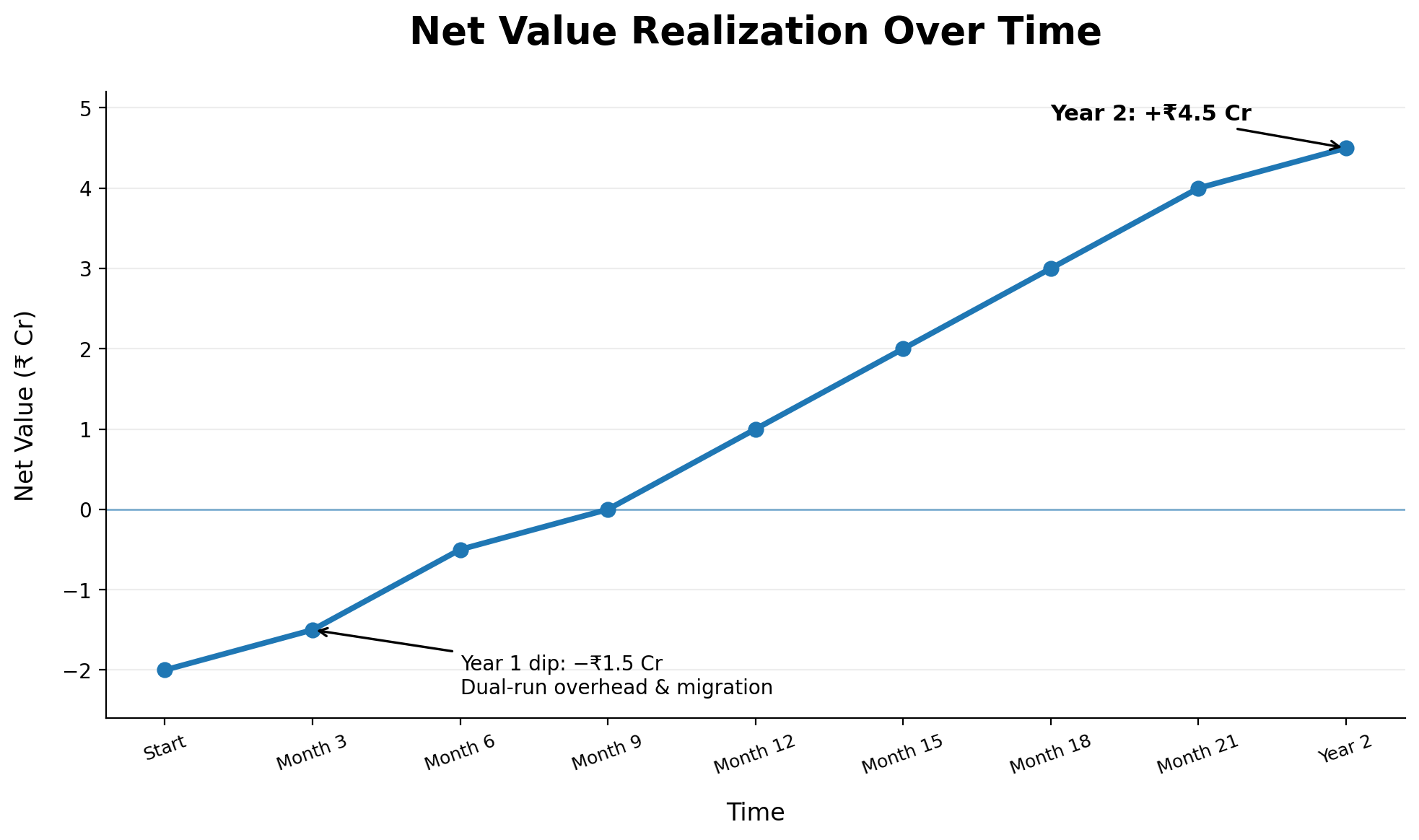
- The Graph & Analytical Signal: Difference-in-Differences (DiD) econometric modeling compares the treatment group against control groups, proving that the Year 1 dip is a temporary investment phase preceding exponential Year 2 value capture.
- Executive Guidance: Maintain Strategic Resolve. Use econometric TVR models to prepare the Board for the Year 1 transformation J-curve, preventing the premature cancellation of high-yielding modernization programs.
Scenario W (SCN-23): The “Zero-Trust Security Zone Violation”
Representative Entities: Internal Reporting Portal (APP025) → Customer Core Ledger (APP004)
Category: Zero-Trust Architecture Audit
-
The Management Blindspot: Corporate networks use traditional perimeter firewalls (“castle-and-moat”). Once an application is inside the corporate VPN, security teams assume internal communications are trusted.
-
The Operational Reality: Graph topological reachability analysis uncovers an unhardened lateral attack path:
-
APP025is a Tier-3 low-criticality internal departmental reporting portal with weak authentication controls. -
A compromised server running
APP025allows an adversary to pivot laterally directly into the core customer database, bypassing perimeter API firewalls entirely!
-
-
The Graph & Analytical Signal: Semantic graph reachability algorithms detect cross-tier directed edges that violate Zero-Trust network containment policies.
-
Executive Guidance: Sever Lateral Pathways Immediately. Mandate zero-trust microsegmentation. Require that all interactions between Tier-3 and Tier-1 systems traverse authenticated, encrypted, and rate-limited API gateways.
Scenario X (SCN-24): The “Multi-Criteria MCDA Portfolio Rationalization Frontier”
Representative Assets: APP021 (Branch Portal), APP035 (Regional Settlement), APP046 (Departmental Timesheet)
Category: Multi-Criteria Decision Analysis (MCDA)
- The Management Blindspot: Portfolio rationalization is typically conducted through ad-hoc annual reviews. A committee reviews one application at a time, debates divisional politics, and rarely makes decisive decommissioning calls.
- The Operational Reality: Single-app reviews miss compound portfolio gains. Using Multi-Criteria Decision Analysis (TOPSIS) across four weighted dimensions—Business Value, Technical Health, Operational Risk, and Fully-Burdened Cost—we map the entire 50-application estate onto a multi-objective Pareto frontier.
- The algorithm isolates three Pareto-dominated systems (
APP021,APP035,APP046) that simultaneously score in the bottom 10th percentile for business value and technical health, while carrying high operational risk. - Decommissioning this 3-application cluster simultaneously unlocks ₹28.5 Crore in annual avoidable spend and permanently severs 12 legacy point-to-point dependencies.
- The algorithm isolates three Pareto-dominated systems (
- The Graph & Analytical Signal: Non-dominated Pareto frontier sorting identifies applications where no dimension can be improved without replacing the asset entirely.
- Executive Guidance: Execute Phased Portfolio Pruning. Package rationalization candidates into bundled decommissioning waves to amortize project management overhead and capture compound financial savings.
Scenario Y (SCN-25): The “Enterprise Strategic Capital Rebalancing Simulation”
Representative Initiative: Enterprise Run-to-Grow Portfolio Rebalancing
Category: Strategic Portfolio Rebalancing
- The Management Blindspot: Large enterprise IT budgets suffer from “run-rate inertia”: 80% of total funding is locked into Run-the-Business (RTB) legacy system maintenance, leaving only 20% for Change-the-Business (CTB) digital growth and innovation.
- The Operational Reality: TVR models an algorithmic capital reallocation engine:
- By capturing avoidable costs across Scenarios B, C, J, K, and X, the enterprise systematically shifts 15.0% of its Run budget (₹18.4 Crore) into strategic growth initiatives.
- This capital is redeployed into high-yield strategic capabilities:
CAP008(Digital Onboarding),CAP022(Real-Time Fraud Prevention), andCAP023(AI Wealth Advisory). - The simulation demonstrates that this 15% capital shift accelerates total enterprise portfolio value by +24.0% over 24 months without requesting a single additional rupee of net new funding from the Board!
- The Graph & Analytical Signal: Linear programming and capital allocation simulations project multi-year portfolio health trajectories under alternative investment allocations.
- Executive Guidance: Present a Self-Funding Transformation Mandate. Present the Board with a self-funding digital roadmap: by pruning legacy waste, the IT organization funds modern AI and customer capabilities out of captured savings.
Summary
Enterprise IT spend pathologies are structural misallocations and hidden risks concealed beneath aggregate financial ledger totals. While traditional general ledgers show aggregate spend by accounting category, they cannot differentiate between high-efficiency scale engines (Scale Anchors) and decaying zombie systems, nor can they trace multi-hop operational dependencies, contract lock-ins, or transformation value gaps.